
The ADA Compliance Checklist for Houston Property Managers
Navigating commercial property management in Greater Houston is a balancing act. Between managing tenant demands, handling the fallout of unpredictable Gulf Coast weather, and keeping overhead low, your to-do list is never-ending. However, there is one critical item that can never be pushed to the back burner: ADA compliance.
For Texas property managers, compliance is a dual-layered challenge. Not only must your property adhere to the federal Americans with Disabilities Act (ADA), but it must also comply with the Texas Accessibility Standards (TAS). In recent years, "drive-by" accessibility lawsuits have targeted commercial properties across Harris, Fort Bend, and Montgomery counties. If your pavement markings are faded, your slopes are too steep, or your signage is missing, your lot is a liability.
Using a strict ADA compliance checklist for your parking lot striping is the most effective way to protect your business from predatory lawsuits while ensuring your property is welcoming to all Texans.
Understanding the Texas Accent on ADA: The TAS Difference
Many national property management firms make the mistake of using a generic, federal checklist for their Texas properties. In the Lone Star State, accessibility is governed by the Texas Department of Licensing and Regulation (TDLR).
The state guidelines, known as the Texas Accessibility Standards (TAS), are often more stringent and specific than federal rules. For example, Texas enforces highly specific rules regarding the location of curb ramps relative to the passenger loading zones and the exact dimensions of warning strips.
Failing a state inspection during a building renovation or after a major restriping project can lead to costly delays, hefty fines, and required remediation work that destroys your initial budget.
The Ultimate Parking Lot ADA Compliance Checklist
When Frontline Striping & Sandblasting evaluates a Houston commercial lot, we use a comprehensive checklist to identify vulnerabilities. Here are the non-negotiable elements your lot must feature:
1. The Correct Ratio of Accessible Stalls
You cannot simply guess how many accessible spaces your lot requires. The total number of parking spaces in your entire lot dictates the mandatory minimum number of accessible stalls.
Total Parking Spaces in Lot | Minimum Number of Accessible Spaces Required |
1 to 25 | 1 |
26 to 50 | 2 |
51 to 75 | 3 |
76 to 100 | 4 |
101 to 150 | 5 |
151 to 200 | 6 |
201 to 500 | 2% of total |
501 to 1,000 | 20 plus 1 for each 100 over 500 |
Note: For every 6 accessible spaces, at least 1 must be "Van Accessible."
2. Precise Stall and Access Aisle Dimensions
Standard accessible spaces must be at least 96 inches (8 feet) wide. However, the access aisle—the hatched area next to the space where a wheelchair user deploys a lift—is where most compliance errors occur:
Standard Access Aisles: Must be at least 60 inches (5 feet) wide.
Van-Accessible Aisles: Must be at least 96 inches (8 feet) wide, though a 60-inch aisle is permitted if the parking space itself is widened to 132 inches (11 feet).
Boundary Markings: The access aisles must be clearly marked with diagonal hatch lines, usually painted in high-contrast blue or white, to deter other drivers from parking in them.
3. Vertical Signage Requirements
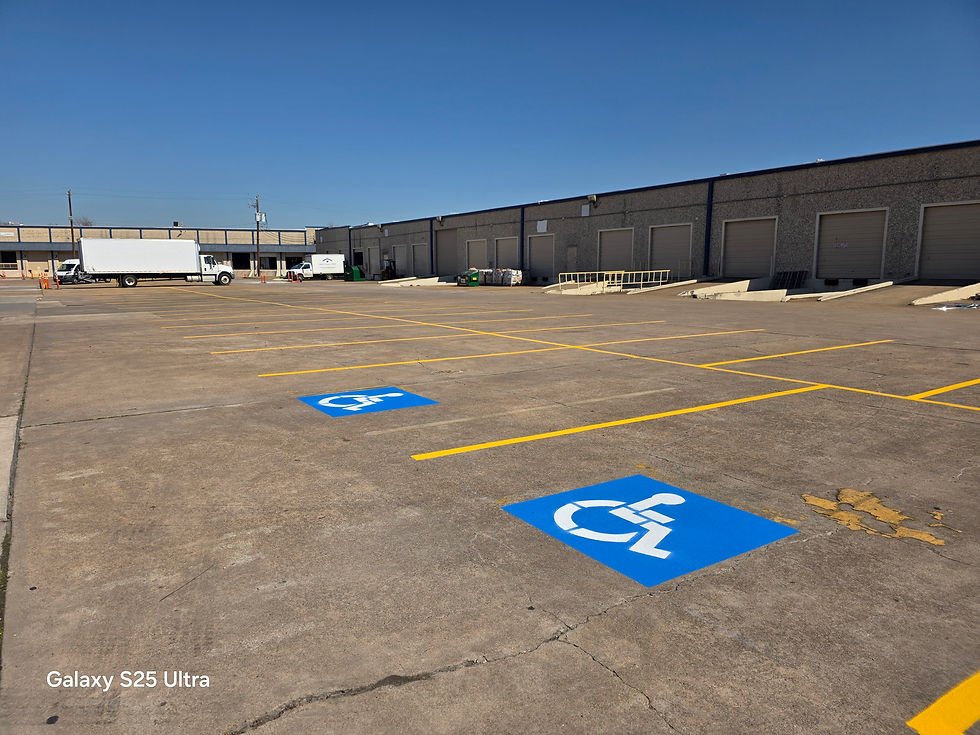
Pavement painted with the International Symbol of Accessibility (the wheelchair icon) is great for visibility, but it is not legally sufficient on its own.
The law requires a permanent, vertically mounted sign showing the symbol. For van-accessible spaces, the sign must also include the phrase "Van Accessible." To prevent these signs from being obscured by large SUVs or trucks, the bottom of the sign must sit at least 60 inches (5 feet) above the finished grade of the parking surface.
4. The 2% Slope Rule (The Silent Violator)
This is where Houston's shifting clay soils create massive legal headaches. The ADA and TAS strictly dictate that accessible parking spaces and their corresponding access aisles must be nearly flat. The maximum allowable slope in any direction is 1:50, or 2%.
As Houston properties settle, shift, or experience minor foundation warping from weather extremes, asphalt can warp. If a surveyor places a digital level on your accessible stall and reads a 2.5% slope, that space is officially non-compliant.
The Houston Factor: Weather, Wear, and Foundation Shifts
Maintaining an accurate ADA compliance checklist in the Greater Houston area requires an understanding of our unique local infrastructure challenges.
Shifting Foundations and Pavement Warp
Our regional soil is notorious for its high concentration of expansive clay. During hot, dry summer months, the clay shrinks; during heavy downpours or flash floods, it swells. This constant movement cracks asphalt and warps concrete. A parking lot that was perfectly compliant five years ago may now have slopes that violate TAS guidelines due to subterranean soil shifting.
Rapid Paint Degradation
Houston’s intense humidity and UV index degrade standard traffic paints faster than in almost any other region. When the blue boundaries or the white hatch lines of an access aisle fade into obscurity, the space legally ceases to exist as a compliant stall. If a code enforcement officer or a plaintiff's attorney cannot clearly distinguish the markings, you are open to penalties.
For a comprehensive breakdown of federal accessibility rules and historical data regarding civil rights compliance for businesses, you can reference the U.S. Department of Justice ADA Title III Technical Assistance Manual.
The Cost of Non-Compliance vs. The Cost of Restriping
Some property managers view parking lot restriping as a purely aesthetic maintenance line item that can be delayed. This is a dangerous financial gamble.
Federal Civil Penalties: The Department of Justice can assess civil penalties of up to $55,000 for a first ADA violation, and up to $110,000 for subsequent violations.
Private Lawsuits: Under Title III of the ADA, private individuals can sue commercial properties for injunctive relief (forcing you to fix the lot) and demand that you pay their attorney's fees. In Texas, these lawsuits frequently settle out of court for thousands of dollars just to avoid skyrocketing legal bills.
Tenant Turnover: If you manage a medical clinic, a retail center, or an office space, your tenants rely on accessible parking for their clients. A non-compliant lot that results in customer frustration or legal notices will quickly cause premium tenants to look for space elsewhere.
By contrast, bringing in a professional layout and striping team to evaluate, sandblast away non-compliant markings, and paint a perfectly measured, TAS-approved layout costs a fraction of a single legal settlement.
How Frontline Eliminates Your Accessibility Liability
At Frontline Striping & Sandblasting, we don't treat compliance as an afterthought. We build it into the DNA of our project planning.
Advanced Field Surveys: We don't just rely on blue blueprints from twenty years ago. We measure your lot's current layout, checking slopes and stall widths with precision tools before a single drop of paint touches the ground.
Total Eradication of Old Lines: If your current layout is non-compliant, simply painting over the old lines with black paint isn't enough. Over time, that black paint wears away, creating "ghost lines" that cause legal ambiguity. We use professional sandblasting to completely erase old, faulty markings down to the bare aggregate.
TAS-Spec Materials: We use commercial-grade, high-solids chlorinated rubber or acrylic waterborne paints that are specifically engineered to retain their vibrant "Handicap Blue" and "Safety Yellow" hues under the intense Texas sun.
Turnkey Signage Installation: We don't just paint the asphalt. We core-drill into concrete or asphalt to install heavy-duty steel signposts at the exact legal heights required by the state of Texas.
For further reference on professional concrete, asphalt, and structural standards across industrial commercial zones, you can consult the structural safety data provided by the American National Standards Institute (ANSI).
Action Steps for Houston Property Managers This Quarter
If you haven't reviewed your parking asset recently, add these three immediate steps to your property management workflow:
Conduct a Visual Audit: Walk your lot during peak hours. Are your accessible stalls clearly visible, or are standard vehicles parking in the access aisles because the hatch marks are faded?
Check the Signs: Ensure that every accessible space has a standing signpost. If a sign is bent, rusted, or loose, it needs to be replaced.
Schedule a Professional Survey: Don't wait for an inspection failure or a legal letter to find out your lot is out of spec.
Conclusion: Accessibility is Good Business
A compliant parking lot is safe, orderly, and legally protected. More importantly, an accessible lot ensures that every single customer, tenant, and visitor can enter your facility safely and with dignity.
Don't let outdated striping or faded paint turn your parking lot into a legal liability. Whether you manage an office park in Sugar Land, a strip center in Katy, or a corporate headquarters in Downtown Houston, Frontline Striping & Sandblasting has the technical expertise to ensure your property meets every federal and Texas state standard. Contact our Houston office today to schedule your comprehensive ADA parking lot evaluation.


Comments